

What Does High Register Mean
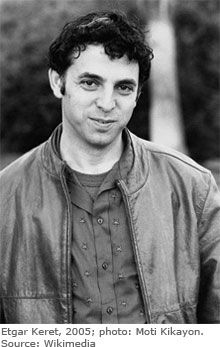 Ieva Lesinska: Does it happen often that you lot get invited to ambassadors' houses?
Etgar Keret: No, not that much. Commonly, when I come up to very pocket-sized countries. And here the administrator, she really likes my stories. And so I don't mind information technology, I don't take a problem with the ambassadors. I have a problem with my foreign government minister, but that's another thing. I was supposed to come here in February, but my father got very ill, he passed abroad since and then. I was in Stockholm so I thought on the manner back I could settle my debt to Riga.
IL: Y'all mentioned your male parent. From your stories it seems that yous were quite shut to your parents.
EK: Oh aye, I'chiliad close to all my family, they're very special people. My mother is even so alive. But I'm very lucky to have somebody like my brother and my sister, and my parents are very special people.
IL: I empathize that both of your parents are Holocaust survivors.
EK: Yes.
IL: Can you lot tell me more than nearly that? What has it meant for you, what has it meant for them, for their lives?
EK: Well, commencement of all I could simply kind of requite you a biographical sketch of my mother, she is from Warsaw. She lost both her parents, her brother, basically her unabridged family unit in the ghetto.
IL: How did she survive?
EK: She first lost her female parent and blood brother, simply she and her father were able to get transferred to some other ghetto, a "milder" one, which was just exterior of Warsaw. There, my gramps, who took function in the Shine insurgence, was defenseless by Germans and killed, too.
IL: Then non in the Ghetto Uprising, merely in the Warsaw Uprising?
EK: Yeah, he collaborated with the Polish underground. But he died before the bodily uprising, he was moving weapons for the underground and was caught. So my mother was on her own, but she was already exterior of the ghetto when information technology was destroyed.
IL: And your father?
EK: Yeah, my father survived the state of war in Baranovichi, now information technology's Belarus, it used to be Poland. He dug a hole in the ground with his parents. The Germans killed his sister. Only with his parents, and two other more distant family members, he dug this very small-scale hole in the ground, in which they could non stand, or lie, they could but sit down, and they were there for six hundred days, when the Russians entered the territory, to accept them out.
They both were survivors. My begetter especially, at that place was something very unique about him. Usually survivors are very suspicious, but he was extremely optimistic, he trusted people, believed in everyone. And I said to him, "Why?" And he said that he had a very tough starting point for life, the Holocaust, but he says that so things kept improving. He said: 'I had very low standards when it comes to assertive in humans, but the longer I live it gets better. He was a very trusting person. And because he survived the Holocaust, and he had his life, he said: "I don't desire to alive one life, I want to live many lives". Then every seven years he would modify his profession. And sometimes he was good at what he did, sometimes he was bad. So for a childhood, sometimes nosotros were at eye course, sometimes we were poor, information technology depends what he did. And he was very, very, very creative, an amazing person.
My female parent is also amazing, in a different style. My mother is tougher. Actually, I wrote a piece about my mother and the house they congenital for me in Poland.one
IL: What house is that?
EK: Well, it'southward a very interesting and weird projection. Information technology was about three years ago, somebody called me on the phone and said in English, with a very heavy Smooth, that he was walking downwardly a street in Warsaw and he saw a gap between two buildings, a narrow gap, and the gap told him that he should build me a house in that location. I said ok, do whatever the gap tells you. You can't argue with the gap, you know. And I forgot all most it. But this human turned out to be a very serious and an extremely talented Polish architect who did all kinds of foreign projects. And after some time he came to Israel. And then basically, the story was that there were these ii buildings with no windows on the sides, and the gap between them was similar 90 centimetres, and people threw garbage in it. There he decided to build me a firm in the proportion of my stories, that would be basically minimalistic, but would accept everything a house needs. I said to him, yous know the land belongs to the municipality, yous don't have whatever upkeep, I don't run across how you can practise it. He said, if you but give me your blessing and I'll practice it. I said ok, and then a couple of weeks ago I was at the opening, and I stayed at the business firm, and it was very, very moving. You can come across it on my Facebook page, they also wrote about it in the New York Times, they've got the photos, and in other places. Information technology's called the Keret House. I stayed there, and at night drunks would come and shout under my window "Keret, we love you!". A lot of people come to visit information technology, because it'south like an art exhibit. And it was very interesting, very moving. The widow of Wladyslaw Szpilman came – the movie The Pianist was based on his novel – and, she was very moved, and many other famous people came. And I got offers of sex as some sort of Jewish-Polish reconciliation, but it didn't work, you know, because I am married. Simply a lot of extreme things happened, it was very beautiful, very moving.
IL: Interesting. Just the house, you programme to stay in it when you are in Warsaw?
EK: The house is basically an artistic projection. But Poland really is a state that I visit more often than other places, both because of my origins and also because it's the state I'thousand near successful in, exterior of State of israel. Just the idea is to take all kinds of artistic operations, to invite other guests to the house, other artists, and as an exhibition it's kind of open. I know that they wrote on Facebook "Who wants to come up?" and more than 3,000 people exercise, so now they have to choose. At the opening, nobody wanted me to read to them. Some of them wanted to read to me in Polish, others wanted communication, similar one of them had an affair with a married man. She didn't know if she should believe him. It was very intimate interaction, it was very prissy.
IL: I only read the book that has come out in Latvian. Before I left for this interview, my daughter, who is eight-and-a-one-half years old, saw the book and asked me if I was sure this was not a volume for children, I said no, it's not a book for children. But I did read her a story.
EK: About the piggy banking concern?
IL: Of course. She wanted me to tell y'all that she actually liked the story, but of course she thought of different ways to cease the story. Basically, the boy should get another hog, a live one, feed information technology, and then they would have each other equally friends, but the piggy bank he should hide in a safe place so that the begetter cannot find it and break it.
EK: It's a better plan. It's funny, because they told me they did this kind of programme in State of israel, where they wanted to get young children from the slums, from very poor and crime-ridden neighbourhoods, to get them interested in reading. Then they gave them this story, and they gave them an practise to continue the story after it ends. And the instructors told me that eighty per centum of them said that the kid leaves the piggy bank in the field, and so a junky comes and breaks the squealer, and takes the coin and buys himself heroine.
Then the way a kid ends the story can tell you lot most how confident he is, and how nice. So your daughter seems to accept a good life and she understands it.
Yous know, when I published this volume in State of israel, I was at the time a pupil at the university, studying for my Grand.A., and this professor who didn't like the book said to me, "I see that your book is successful, but it cannot be too deep. I took this story, and I read information technology to my daughter who is 8 year onetime and she understood it". And I said to him, offset of all, I'chiliad sorry that you detect your daughter shallow. Simply likewise information technology concerns aesthetics, because when I studied in university I first studied mathematics, and in mathematics the all-time and most artful proof is a proof that is accessible to somebody who doesn't know mathematics. So if I can come up upwards with proof that just a professor of mathematics tin can understand, information technology means that it's non every bit practiced as, say, Pythagoras. What I took from this short time that I studied maths is this: that I really wanted to write stories that your daughter can read, a taxi driver can read and somebody else can read, and each tin read from it as much as he or she can.
IL: Then are y'all moving toward the shorter and shorter? Are you somewhen going to be ane of these people who publish the 140 character Twitter line?
EK: No, no! Actually, in my latest drove, the stories are slightly longer, not much longer, but just slightly longer – four pages, six pages, but the aesthetics is like.
IL: Practise y'all start out with a longer story and then peel it down?
EK: Yeah. They're pretty short to begin with, simply the editing process with me is always kind of making it shorter and shorter. Permit's say, when I write the stories, I am really more like the reader and non the writer, meaning that I write them because I want to know what's going to happen. And I think this as well creates some sort of an impatience. It's like somebody tells you a story, and you desire to know what happens, and then he starts describing the leaves of the tree, and you say, "Stop going on and on virtually that, what happened to the girl?", you know? I feel very much at peace when I write. For me writing is some kind of management, a space. And when I edit, many times I run into that in that location are things I needed them to sympathise the story, but now that the story is there, they're no longer necessary. And so I very seldom add together things, I mostly have things off when I edit.
IL: How about the translations of your stories? Obviously you can't read all of them. How much are they really dependent on the Hebrew linguistic communication? What is lost in translation? You tin can obviously read at least the English translations.
EK: Well, the thing is, in Israel, when I was first accustomed, the affair that everybody talked nigh, including critics – some liked what I wrote, some hated information technology – was the language I used. Considering in Israel, traditionally, writers write in very high register because the Hebrew language has a strange history. It existed equally only a written linguistic communication for two chiliad years, and people didn't speak information technology. They spoke Yiddish, or Ladino, but they didn't speak Hebrew. Then it has some sort of a holy status. Even in modernistic times, when people write fiction, they know that their volume volition be put on the shelf next to the Bible. So when I started writing I wrote in the colloquial speech, which is something that wasn't very common. And I had this thing that I would do, I would invent words or do things that are not in the Israeli tradition of writing. Some people liked it, some people thought that it was disrespectful of the language. Simply the thing is, when I work with my translators, they say that they cannot interpret the way that I write into other languages because of this special historical language. The Hebrew language didn't develop organically: basically, from some moment in history, people started speaking it, and this created a tension in the linguistic communication itself, with the biblical fundamentals – unlike English that has changed through the years. If somebody who spoke English language in medieval time would heed to the 2 of u.s. I bet he would hardly sympathize a word. But if anyone would hear me speaking Hebrew, he would sympathize most of what I'm saying.
IL: Except for the slang.
EK: Except for the slang. But even when you use slang, basically I would say half the words used are biblical. The other half are those words that, in this gap of two thousand years, people needed merely that were not in the Bible. For example: water tap, tire and the like. So because words were needed immediately, they can be easily imported from other languages and put in the Hebrew form: so I tin take a Russian word and put it in the Hebrew form, but I can also invent a give-and-take, which people can hands empathise from the context, because they're used to the fact that all the time somebody tries to explain something, simply doesn't have the discussion.
So this creates an interesting tension within the sentence. You accept biblical words, but likewise a totally kind of invented, or imported words. Which means that the English language equivalent is that you have a sentence that is half Male monarch James Bible, one-half Jay-Z rap, y'all know? When y'all say a sentence, the register may become like this: biblical, biblical, Arabic, biblical, Russian, biblical… And this is something you cannot practise in some other language. Then many times the translator says, you tin can either bring all the register up, or take all of it downward, merely it cannot be both. To me, however, this kind of captures the spirit of the Israeli nation, which is both ancient and extremely young. This tension between religious and conservative and liberal and anarchistic is in the Israeli society all the time.
IL: In Latvian the translators seem to have taken the register downwardly, and the language is very vernacular.
EK: Merely I think that's what most translators do. They cannot go along the tension and most of the stories wouldn't comport an extremely high register. You lot wouldn't want to have a child speaking like a prophet, would you?
IL: It could exist interesting. But I wanted to ask you about the last story in the volume, which is about suicide. You lot as well take a movie near suicides who meet in afterlife. What is it almost suicide that fascinates you lot? Or are yous more interested in afterlife?
EK: I tin give you two answers. I can give you lot a biographical one, and an aesthetic one.
IL: Give me both.
EK: Ok. First of all, I must say that there is something about suicide that information technology is very of import from the moral point of view: you lot have reached a signal that helps you look at your life both as an insider and an outsider, because yous're standing at this gate of leaving. And this idea that y'all take a choice regarding your life is also very interesting. Basically it breaks the inertia of life. It'south a powerful metaphor that I have used in unlike ways in different stories. When I wrote "Kneller's Summer Army camp", it wasn't about suicide, it was nigh my life at that period, when I hung out with people who'd been there, washed that. All of united states had been in the army, seen people dying, nosotros experimented with all the drugs yous tin retrieve of. You know, there were so many overwhelming experiences nosotros'd been through that basically we were kind of outsiders to life. For me, the metaphor of suicide, people who gave up on life, is very good for that. In some deep sense, I found my way back to life through honey, through falling in dear – that meant reconnecting again to life.
I must say that, on a biographical level, quite a few people who were very close to me committed suicide. My best friend killed himself when we were together in the ground forces. My showtime girlfriend killed herself, albeit a long time after nosotros parted, a couple of other people… When my best friend killed himself, we were together in the army, and I was the one who found him after he shot himself. A week subsequently I wrote my first story, "Pipes". I feel that there was something in suicide that afflicted my life – a lot. Non only because I started writing. Even before this I was very unhappy with my life, peculiarly when I was in the regular army – in that location it is very easy to exist unhappy with your life. But once my friend killed himself, he put me in the spot where I had to confront the facts of life and make a choice, and if I chose not to impale myself, that meant that I had some responsibility for it, had to give it some sense. And I call up "Pipes" is just about that, yous know. I don't remember information technology's a coincidence that information technology's the first story that I've written, because basically the story says, if you are unhappy, observe a mode out of that, detect a way to alive your life. If your answer to the question why non kill yourself is that y'all want to alive, then it'due south like entering an apartment, and it's a dump. You could have said, "No thanks, I don't want to be here, information technology's not really mine". But if yous say "yeah, I want to exist here", and then the first thing y'all do is begin cleaning the flooring, right?
IL: And how is your life now that, if I understand what you are saying, y'all have cleaned the flooring? I don't mean to get very personal…
EK: You can get personal! To tell you the truth, the farther the place I get to is from where I live, the more sincere I become. When I'1000 in Israel, I never talk near anything personal, in the Usa and England I talk more, and when I go to Latvia or Lithuania or Korea, I get very very sincere.
IL: That's adept. I've never been to Israel, but I think it's a pretty harsh place to live – and so I'd like to know how y'all feel there.
EK: Like everything else in State of israel, information technology'due south very contradictory and paradoxical. For case, Israel is one of the safest places on earth, in the sense that a child or a adult female can walk the streets at 3 a.m. and they won't exist harassed, nobody will touch on them. Nosotros hardly have whatever criminal offence, we live in this very friendly community. On the other mitt, we are in a never ending conflict. During the 2nd intifada, many people I knew died, or they somehow got hurt. The place I had coffee every twenty-four hours got bombed, the place I would go with my parents out on Fridays for dinner was attacked. More than one time, I would stand up in the street and hear a loud "boom", and see smoke billowing. I was at my parent's house during the offset Gulf War, and a missile hit the house next to u.s.a.. Much of the fourth dimension you feel extremely safe until y'all're not, you know? So its not this kind of feeling where I wake upwardly and say "Wow, I live in a dangerous place!" Only I think that this kind of matter is always at the back of my mind, at the back of everybody'due south mind, and this is why, on a subconscious level, everybody'due south very very stressed, and this is turned into some superficial passion, like people watch shitty reality shows and look for recipes on the internet, and worry about sending their kids to the right school. Information technology's a very bipolar situation.
Once I wrote a piece about my acupuncturist. At the time I grew a moustache, and he started talking to me about this moustache. He said, "Oh, the final time I had a moustache…" And he told me he was in a special ground forces unit, in which he did reserve duty, and they would become across the border to Lebanon, and in one case they told them that if they met someone carrying a weapon, they must impale them immediately. And then he saw someone, and he wanted to kill him, but then, just seconds before pulling the trigger, he realized the guy wasn't holding a rifle but an umbrella. So this guy could exist twenty days a twelvemonth a killer, and the rest of the twelvemonth a human-rights activist, a left-winger who doesn't allow his children play with guns considering guns hateful violence. Or, allow'due south take the difference betwixt me and a Latvian my historic period. If you happened to be my girlfriend, and I came to y'all only you locked the door and said, "I don't want to encounter yous anymore, get lost", then I wouldn't come in out of respect for you. Simply I know how to kick a door in; the fact that yous lock it doesn't hateful shit to me. And so there is this kind of feeling that, let's say, unlike many, especially western societies, where civilization seems to be part of the ontology, in Israel the feeling is that it's a pick. We are playing this game where nosotros are very very civilized, but the next moment we can crush and destroy. I run across a guy with a burglarize and I will either take to kill him or he'll kill me. And so in that location is something stressful about this.
I go with my three-year-old to a park and he is playing with other three-yr-olds, but then 1 of the mothers says to me, "And then, when he is eighteen, he is going to go to the army, right?" because it's compulsory. But if he claimed that he was mentally disturbed or had some other problem, he could attempt and cheat the system, like y'all could here when the Soviet army was here. And then I say to them, "Only he is only 3! I don't know what he'll practice." And so they criticize me, saying that I am this or that, and basically a hippie. And so there is something almost this mentality, it is half normal, half totally insane. And I'm certain the people who alive information technology are non aware of it that much, merely like people here do not realize how damned dark and cold it is here.
When I was five years old, I think I was in our living room, when the Yom Kippur war had started, and they came in this ground forces car to accept my father to the front. Nosotros knew that there was a good hazard that he'd die, and I all the same remember my father taking a piece of newspaper and writing downwards all the debts that he had – like he bought cigarettes in the local kiosk on credit. He left the note to my mother, so she'd know whom to pay what. And you run across this list and you realize that the only reason that he'southward made it is because he might die. For me these things accept always been very stressful. Near Israelis would say I'1000 a pussy, merely for me it'south always very stressful.
IL: Would you say that you're a pacifist?
EK: I'm definitely not a pacifist. My married woman would even claim that I'm a very ambitious person. I had my nose cleaved, I have scars…
IL: You get into fights?
EK: Yeah. The last twenty years I've been much quieter. I mostly fought with other soldiers when I was in the ground forces – since I was a mathematician, I did not really see combat. Equally a Holocaust survivor, my mother who was raised in orphanages always taught me not to avoid conflicts. Considering in an orphanage if a girl said, "Ok, ok, whatsoever yous desire", she could become raped, you lot know. So the idea was that you always have to fight. I can't say I am terribly aggressive, but I'm not a pacifist. And actually, I don't believe in pacifism. At the same time, I'one thousand not even disgusted by violence – information technology only gets me totally depressed. When my son was little, he was about to step on a cockroach. I stopped him, and he asked me why. I said to him, "Practise you know how to make a new one?" He said no. I said, "Never pause what you don't know how to make. Yous can break anything in the firm if you know how to make it. If you don't, respect information technology" I've been in enough situations where I couldn't avoid confrontation, or I had to fight for something which I thought was important. Only at the same time, I've been a vegetarian since the age of 5.
IL: Why is that?
EK: I saw "Bambi", and I asked my father why the hunters shot Bambi'south mother? And he said, "To make a schnitzel for you!" So I said, ok, I'm not eating Bambi's family unit. Then there was a big argument in my family unit about whether Bambi had any friends or relatives which were fish. It wasn't YouTube time, so we couldn't just check it. I claimed there was a fish in the Disney cartoon, just now, forty years afterwards, I have to admit that at that place was none. But I remembered some animated fish from somewhere, and I haven't eaten meat ever since.
IL: The late historian Tony Judt has said that Israel strikes him as an East European state, but that it would do it much skilful to finally realize that it is a Middle East country. But in your movie "Jellyfish" it really struck me that the whole aesthetic, and non just the characters, was kind of East European.
EK: I recall this may accept something to do with fact that I'm of Polish descent and that my wife comes from a family that is half Russian. I call back Israel has so many contradicting realities, I could make a movie where the aforementioned city would wait completely Mediterranean. It's nigh the place yous come from. I come from a house where my parents spoke Polish, and the books that I read were by and large East European, then it was very natural for me to assume this aesthetic. That is why it'southward non a surprise for me that, allow's say readers from Poland and Russian federation find it easy to connect to what I write about. We can besides talk near Israel as beingness an Eastern European country in the sense that we were for many years a socialist land. We were non communist, merely nosotros were socialist, with kibbutzes, one government channel on TV, with all kinds of stuff that was not imported to the country because it was considered an unnecessary luxury.
IL: Was Israel a improve country then?
EK: My instinct is to say yes. I'm very much afraid of nostalgic thoughts, but what I can say is instinctively is that I really don't believe in the backer system when information technology's pushed to its limits. I recall that every system, when information technology'southward pushed to its limits, is dangerous. As you lot well know, communism meant low, the inability to say what y'all wanted, lack of freedom. Just in capitalism, I discover it weird that the cure for AIDS is patent-protected. That'due south why there are millions of people dying in Africa: not because their pharmacies could not prepare the medicine, taking two substances and mixing them together, but because they tin can't pay for the patent. This is completely perverse. Imagine ii deer in the forest, and i of them has a wound, and it wants to wash information technology in water. Only the other deer says, "But I invented the concept of washing it in h2o, so if you don't give me something nice to swallow, I will not let you to apply my thought of washing your wound!" Information technology seems totally ridiculous. We alive in a social club with globalization and all the gaps between the rich and the poor becoming ever wider, nosotros go along talking about commonwealth and capitalism as some sort of a wonderful idea of full freedom and mobility, but if you're built-in in the wrong family in the wrong time, you might as well take been built-in a poor fellah in a totalitarian kingdom. I think it'southward much better if there'south some remainder between the free market and a socialist government.
IL: Like in northern Europe?
EK: Yeah, like in Scandinavia. I read about this very interesting experiment they did in America. They asked Americans, both very rich and very poor, "What do you lot think of the gap between the rich and the poor? Would you lot hold to pay more taxes?" Of grade, the rich people said that they didn't desire anything inverse, and the poor people said that yes, they wanted higher taxes, health insurance and so on. And then they said to these same people, "Imagine that you can offset your life from the beginning again, but you don't know in which family unit yous will be born, a poor or a rich 1. So which kind of guild would y'all want to live in?" And and then everybody, both the rich and the poor, voted for a Scandinavian model.
IL: I know that y'all accept been criticized for existence also apolitical, so I will enquire yous a traditional question, which is: How much involvement in politics should a author have, and how involved are you?
EK: Showtime of all, I must say that I call back that as a writer you basically celebrate your own individualism, and so I recollect information technology's very natural that some people would be much more involved than others. I really don't believe in a kind of a writer's order police force, what a writer should or shouldn't do. It depends on what kind of writer you are. I'm actually very political. I'm a liberal left-winger and, amidst other things, I interviewed our prime government minister, our right-fly prime minister, and got him into a huge trouble with the Country Department. He knows me on a first-proper name basis, and usually curses after he says my proper name. At the same time, I don't go with the Israeli tradition, for example, of endorsing political parties for the elections, which is something I would detect disrespectful both to my fine art and to people. Endorsing a political party, for me, has the aforementioned morality as endorsing Nike shoes or Pizza Hut. I truly believe my stories are much more than intelligent than I am, so I remember that if somebody reads my stories, it may brand him encounter the globe slightly different, or maybe even bear upon his decisions. But saying "Hey, I've written stories that you similar, I accept more than money than you lot, I have a beautiful wife, so listen and do what I tell you to do", doesn't seem extremely autonomous or respectful. It's both exploiting the stories, and exploiting my readers for something I don't particularly like. I call up that every election, every time I voted in my life, it was choosing the lesser evil.
IL: Isn't that a characteristic of the contemporary world? It'south the same here, it's the same everywhere, I call up. I don't know, maybe the American Republicans vote differently, but generally it e'er seems as choosing the lesser evil.
EK: Yeah! But having said that, I don't want to tell people to vote for a party in which I have doubt. Simply in State of israel this is considered by some old-school writers as very decadent and idealistic and irresponsible. I likewise write op-eds for Israeli papers, for the New York Times, Guardian, Le Monde, but I never do information technology in a kind of dramatic way that is normally expected of me. In many of my pieces I am committed to an idea, just at the same fourth dimension there is some ambiguity, which people tend not to similar in political soapbox. It is frowned upon equally showing that yous are indecisive or whatever. Merely I recall that as an creative person, it is my job to show life in its complexity. It seems strange that when I write about politics I'thou expected to take complex reality and reduce it. It seems that even Amos Oz, whom I really similar and respect, expects something like this…
IL: You must be a heed reader, I was just thinking about asking you about Amos Oz.
EK: When I first started publishing, a lot of onetime-schoolhouse writers were confronting me, but Amos was the person who helped me the most. He would always advocate my writing, and aid me in State of israel and overseas. And I really really similar him. We're dissimilar, just we really like each other. So Amos once said that he has two pens on his tabular array, one with which he writes fiction, and the other with which he writes essays. But I said to him: "Amos, at present I understand what y'all mean, because I write both my stories and essays on one and the aforementioned computer." I really could never write a manifesto. My position is rather that of a court jester in the state of the convinced, of people who basically know what is right and what'due south wrong. I think that many times in my essays I'1000 trying to prove reality from a dissimilar angle. Nosotros live in a very tribal society. Nosotros accept the left wing and the right wing, and they are very much like football lodge supporters. You lot know, the moment that yous meet somebody who doesn't support your team, you don't actually listen to them. But if there'due south somebody who builds an argument that is not confronting the fashion that you call up, but but changes the way that you perceive reality, then there may be a hazard for modify.
IL: I take another traditional question, which yous as a person who perceives the complication of reality may not want to respond: what, in your opinion, would be the best solution to the problem betwixt State of israel and the Palestinians – one state? Two states?
EK: My blood brother is a staunch supporter of the one-state solution. Ideally, I would back up information technology too, but nosotros are living in a reality where two peoples are trying to kill each other. I think that no agreement can turn grudges that have lasted for more than 60 years into a beautiful friendship. That the children of those who a yr earlier sent a suicide bomber to kill a family and the children of the soldier who knocked on the door and arrested the gramps, may go to the same school and become friends is somewhat utopian. I would say that the two-state solution could be a station on the way to a one-country solution, ideally. Merely we live in societies that are culturally and socially different. I come up from Tel Aviv where we agree a earth-famous gay parade, only if you become to Gaza, and they know you are gay, yous may just terminate up dead. Then I really think that there is something very ambitious and naive in hoping for a 1-state solution. I think that many times for people to speak about the one-country solution is a way of not accepting whatsoever solution. A 2-state solution would be a compromise. And I think that if you're unwilling for a compromise, but non totally sincere about it, then you would say "I want something I cannot have". And that is a good style of basically conserving the situation you are in. I actually retrieve that many people call back the 2-state solution would exist unfair, simply it is the nature of compromises, that they are unfair.
IL: Have you ever been translated in Arabic?
EK: Yes. Really, I think during the 2d intifada I was the only writer who was translated into Arabic and published in the Palestinian Authorisation. I have a very long story near information technology, but I don't know if…
IL: Become ahead.
EK: Peachy. And so I recall it was in 2002, and I was in Stavanger in Norway where I attended this symposium chosen "Centrality of Evil, Centrality of Promise" – a kind of a post-9/xi effect. I was supposed to sit there on a console with two Palestinian writers, and a writer from Boston. It was a panel of writers who write in troubled and violent places. But the two Palestinian writers refused to sit with me on the stage. And the Norwegians, as nearly Scandinavians who are very afraid of disharmonize, immediately, simply without talking to me, secretly moved me to another panel, it was something like "Women who started writing subsequently giving birth". Of course it was all very awkward. Merely I met the Palestinian writers, who were both very nice, and they said "Listen, nosotros like you. Merely we cannot sit on stage with an occupier". And they asked if I understood their position. I replied that I don't understand information technology, only I respect it. The person who was supposed to give the closing speech was the late Jacques Derrida. He was supposed to talk almost something, I don't recall the topic. But before he came on stage, somebody had told him about the Palestinians and me, and instead of talking about whatsoever he had prepared, he gave this spoken communication attacking the Palestinians and attacking the Norwegian organizers. And he said to the Palestinians, "You say that y'all want peace, but if you won't sit on phase with this picayune left-wing writer, then how do you await that your leaders will sit with Ariel Sharon, who is a war-mongering general? Basically, yous have stated that you really don't want peace, and it'southward bullshit, yous're cowards." He was very passionate and aggressive, and a very heated conversation ensued. At some stage, the Norwegians, who were very uneasy wanted to find a way out, so they suggested that perhaps nosotros could all have breakfast together: the Palestinians, Derrida and myself. So anybody accepted. At breakfast, Derrida asked me about my writing and he asked if I could provide him with a copy of my volume. And then I gave him the copy from which I read at events. But then 1 of the Palestinian writers said "Tin I have a re-create, too?" And I said to him that I only had i. But afterward I felt that he didn't believe me, that he but thought that I didn't want him to take my book. And so I asked the organizers for the Palestinian's address, and I sent him a copy by post, in English because he didn't read Hebrew. He didn't reply, didn't write back, and then 7 months later I got an email from him. He said: "I really like your book, I translated it into Arabic, would information technology be ok if I published it?" I said certain, merely mentioned that it was perhaps not the best time, what with the Israeli bombardments of the territories and the bombings in State of israel. He said, "I don't care. I retrieve you take a sensibility that people here don't know. And I think it's important that they know. I don't mind if I get into trouble". He was a very dauntless human being. His son was killed by the Israeli Defense Forces. Every time the book was about to get published there would be another IDF assassination. The publisher said, ok, information technology's not a skillful week, we should do it next week. And at some phase the translator died from a heart condition, and a few weeks later the volume came out, and nosotros dedicated it to him. When I talked to the publisher, and asked him how the book was doing, he said, "Yous know, I don't know what to tell you. All the copies of the book are going actually fast, simply I still haven't figured out if you have then many fans here, or if the Hamas is burning them".
Luckily, I have met quite a few Palestinians who have read the book, and so it couldn't just exist the Hamas.

What Does High Register Mean,
Source: https://www.eurozine.com/high-register-low-register/
Posted by: bradleyawitin.blogspot.com
0 Response to "What Does High Register Mean"
Post a Comment