

Can I Install A Ceiling Register In My Detached Garage
Yous run into roof vents on big box retail stores, warehouses and factories, all the fourth dimension every bit you lot drive past them. But Why Does A Detached Garage Need Roof Vents? Roof Vents in the Garage are not mandatory but they can meliorate ventilation, especially in a detached garage.
Roof Vents in a Detached Garage can increment air circulation and cool down the garage in hot conditions. A Detached Garage with Roof Vents will become a healthier and a more livable space. The chances of mold growth or pest infiltration will also be reduced.
In this post I volition explain what roof vents are, how they work, and how a detached garage tin can do good from installing a few roof vents. I will also explicate why air apportionment is important and what are the recommended levels.
What are Roof Vents & How exercise they Work?
You might have noticed vertical cylindrical structures jutting out of large retail stores, warehouses or factories. I must say they do not expect pretty. Simply they are there for a very of import reason. They are the roof vents or the roof turbines that keep the air moving.
Roof vents or roof turbines are in fact turbines. Curved fan-like blades are mounted on a central axle. Fifty-fifty a small-scale air motion sets the blades in movement. Just like a fan, the roof vent moves the air from the inside of the garage to the outside.
You demand ventilation in a garage, merely like yous need ventilation in your house. If anything at that place are more than reasons for ventilation in a garage. You need ventilation irrespective of whether the garage is insulated or uninsulated, fastened or detached.
Passive Roof Vents
Passive roof vents are one of the garage ventilation options at your disposal. Passive roof vents do non require an free energy source as they utilise the natural motility of air.
Hot air is lighter than common cold air and it rises up. This upward movement of hot air within a building, such as a garage, is enough to set the roof turbines in movement. Any wind will further increment the effectiveness of the Roof Current of air Turbine.
The warm air moves out of the garage to the exteriors. Information technology is replaced past common cold air from the garage wall vents or the garage door. The fan blade curves are designed such that the roof vent acts like a one way valve. Air can become out but tin can not come in.
A air current powered roof turbine is an energy neutral fashion to get the hot air out of your garage. It cools every bit it ventilates and does non cost anything to run. Needs minimal maintenance too. Passive Roof Turbines are very useful when you need to accept your garage cranium vented.
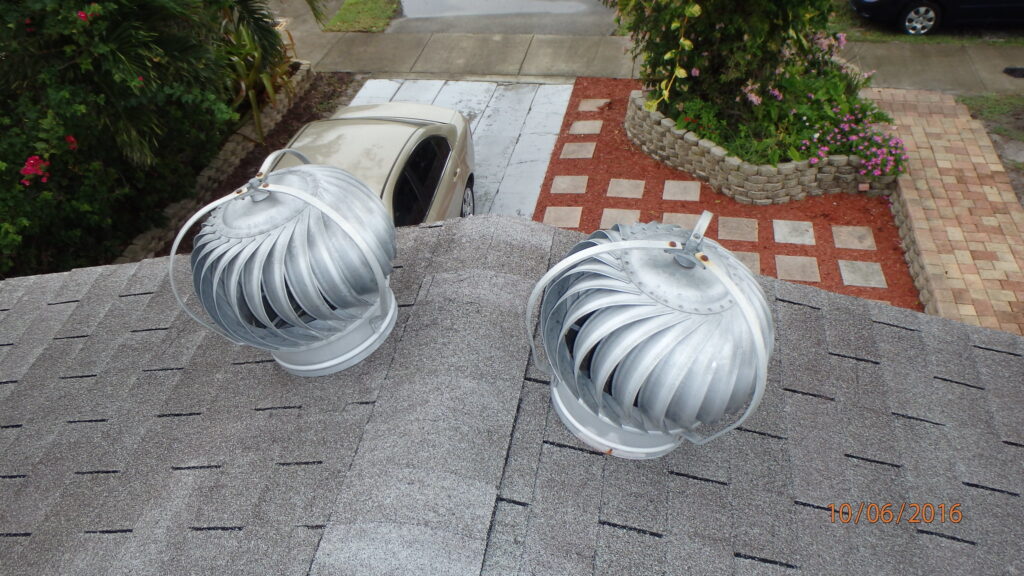
Go 12 in. Mill Cease Aluminum Internally Braced Whirlybird Wind Turbine at Dwelling Depot
Solar Powered Roof Vents
Solar powered roof vents for a garage are a not bad option. In summertime the hot sunday can heat up your garage to unbearable levels, but a solar powered roof vent can use the sun's radiation to run the roof turbine and absurd the garage, for free.
Maybe the wind in your area is not enough. In which case a roof air current turbine may not be able to do the task. In that case yous can install a roof mountain attic fan. Think of information technology as an exhaust fan for the roof.
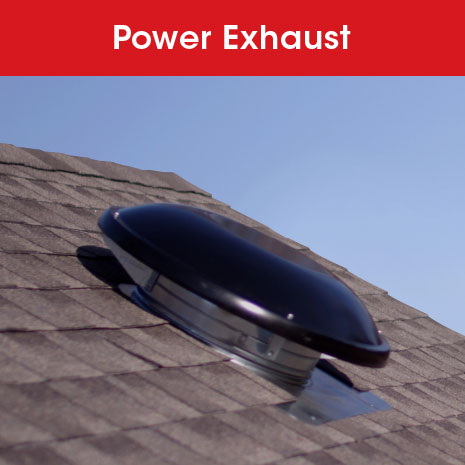
Check out 1000 CFM Manufacturing plant Ability Roof Mount Attic Fan from Masterflow at Habitation Depot. It is available in Electrical, Solar or Hybrid options.
Roof Vents with Exhaust Fans
At times it may become necessary to use power roof vents to eliminate toxic or obnoxious fumes. The garage may not be hot enough to ready the desired rate of air movement. An exhaust fan, connected to the roof vent, directly or using a duct will be helpful.
Roof Vents Keep a Detached Garage Cool in Summer
Most detached garages have but 1 opening, the garage door. Some may have a side door. You may add a window to one of the walls. However, windows in detached garages are not such a great idea as burglars tin easily get through them.
In summer, particularly in the southern states, the temperature outside hovers above the 100 deg F mark. Approximate what the temperature inside the detached garage that is not insulated, non ventilated and not air conditioned.
The detached garage will be at to the lowest degree 20 deg F higher.
There is no mode you lot can exist in that garage and get any piece of work washed. Even when you are non using the garage, imagine how your cars and other valuables are degrading in the intense rut.
A hot discrete garage, without a roof vent, is also bad news for the roof shingles, as all the hot air sits just under them.
Installing a few roof vents in the detached garage are an like shooting fish in a barrel way to keep your detached garage cool, even when the doors are closed. Once installed, in that location will be no running toll in instance of passive or solar powered roof vent.
Roof Vents in a Detached Garage Eliminate Fumes
A detached garage, peculiarly the 1 that is sparsely used, is poorly ventilated. The garage door may not be opened for long periods of fourth dimension. Fumes may build up in the garage. Some of them are just obnoxious while others could actually exist hazardous.
Some fumes to be aware of are listed beneath:
Carbon Monoxide from car frazzle is a poisonous gas, colorless, odorless and tasteless gas. It deprives the centre of oxygen and can result in loss of consciousness and suffocation.
Gasoline Fumes from leaks in automobile fuel tanks & lines, spills from jerry cans etc. The fumes are flammable.
Chemical Fumes from improperly stored paints and garden & cleaning chemicals.
A ventilation organization where you have Garage Wall Vents in the lower half of the garage and Roof Vents on the tiptop, will maintain good air circulation.
Fumes will be eliminated from the detached garage through the roof vents. All this volition be accomplished passively and without any running cost or effort.
Roof Vents in a Detached Garage Discourage Mold Growth
The chances of growth of mold & mildew in a discrete garage are very loftier. You volition know that in that location is mold growth in your garage by the unmistakable musty smell.
Both mold & mildew can have adverse effects on human health.
The agin effects of mold on human health can include respiratory issues, such as asthma, centre bug, articulation pain, migraines, fatigue and depression.
The adverse effects of mildew on homo health are relatively milder. Inhaling mildew can lead to coughing, breathing difficulty and headaches.
Mold & Mildew tend to thrive in a detached garage. Mold spores are in the air, everywhere, all the fourth dimension. All they need is to state on the garage wall or some other spot that volition provide them with the environment they grow in. They need:
- Organic food sources such as wood, textiles, paper etc.
- Loftier humidity or damp, wet surfaces & some warmth
- Dark, dingy lighting conditions &
- Poor air apportionment
A discrete garage tin can provide them with all of these.
Roof Vents increase air apportionment and discourage mold & mildew growth to an extent.
How Much Ventilation does a Detached Garage Require?
Section 312.1 of the 2018 International Building Code (IBC) lists Individual Garages in the "Utilities and Miscellaneous Grouping U". Buildings & Structures in Group U are not classified in any Specific Occupancy Group.
However, IBC does state that such buildings & structures "shall be synthetic, equipped and maintained to conform to the requirements of this lawmaking commensurate with the burn and life chance incidental to their occupancy"
While this leaves a lot to the sentence and estimation of the local building lawmaking authorities, you must keep in mind that a garage, even a detached garage, has evolved far beyond a "utility" space.
I would strongly recommend that a detached garage should be ventilated to comply with The US Environmental Protection Agency (EPA) guidelines and ANSI/ASHRAE Standard 62.2-2019 for living spaces, as far equally possible.
Indoor Air Quality
The US Environmental Protection Agency (EPA) defines Indoor Air Quality (IAQ) as:
Indoor Air Quality (IAQ) refers to the air quality within and effectually buildings and structures, especially as it relates to the health and condolement of building occupants.
On the aforementioned website they give the recommended air changes per hour as per ASHRAE
ASHRAE (formerly chosen the American Society of Heating, Refrigerating and Air-Conditioning Engineers) recommends (in its Standard 62.2-2019, "Ventilation and Acceptable Indoor Air Quality in Residential Buildings") that homes receive 0.35 air changes per hour but not less than 15 cubic feet of air per minute (cfm) per person. equally the minimum ventilation rates in residential buildings in order to provide IAQ that is acceptable to human occupants and that minimizes adverse health effects.
Cheers very much for reading the mail. I do hope you lot found it informative and useful.

Source: https://garagemadesimple.com/does-a-detached-garage-need-roof-vents/
Posted by: bradleyawitin.blogspot.com
0 Response to "Can I Install A Ceiling Register In My Detached Garage"
Post a Comment